Know what's inside your oil.
Cold-pressed oils with transparent sourcing, batch traceability and laboratory testing.
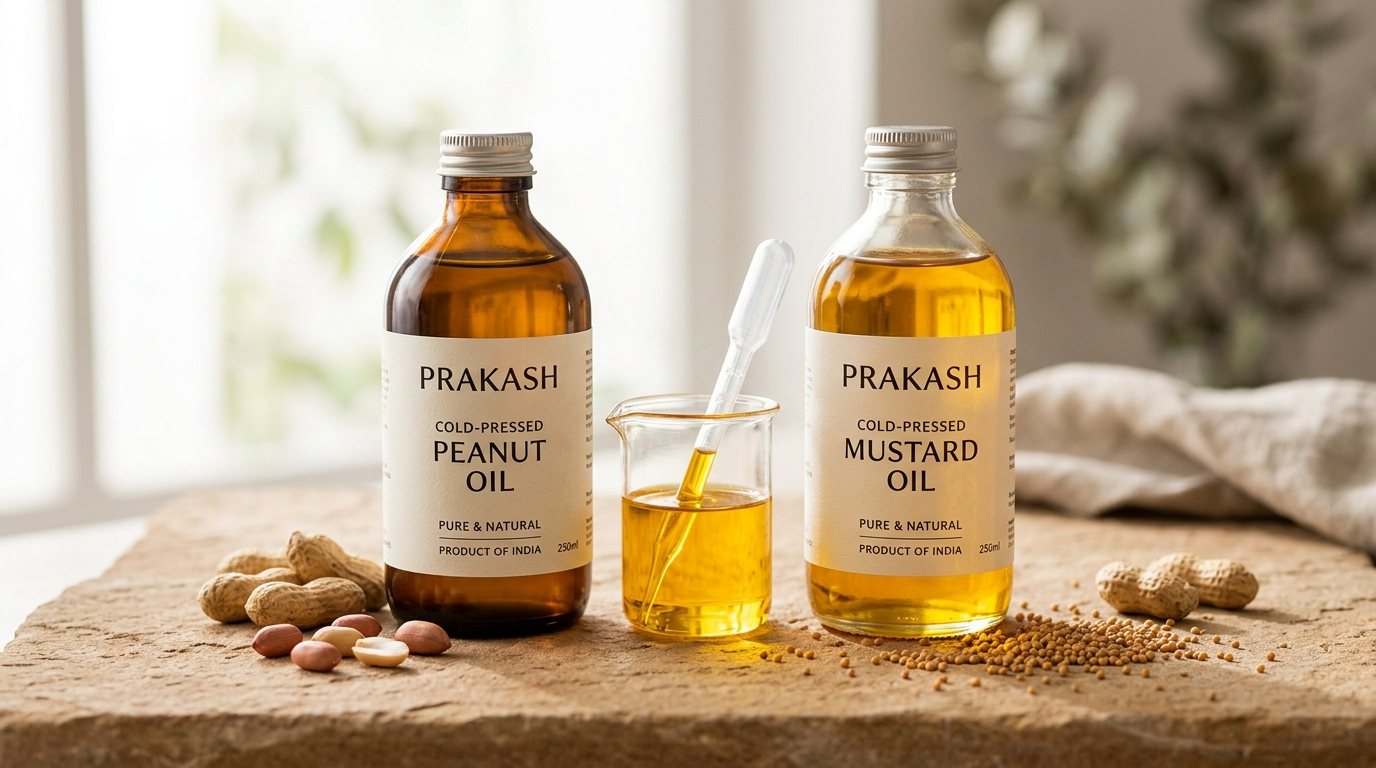
Single-Origin Cold-Pressed Oils
Slow wood-pressed from regionally distinct Indian oilseeds. Unbleached, unrefined, and bottled in dark amber glass with verified batch reports.
Why Transparency Matters in Edible Oil
In an industry dominated by opaque refining blends and generic "organic" buzzwords, we provide verifiable data at every touchpoint.
Liquid Paraffin & Cheap Palm Blends
Edible vegetable oils are historically susceptible to adulteration with non-edible mineral oils or cheap imported refined palm olein. We test every batch with Holde's Saponification and Gas Chromatography fatty acid profiling to prove zero dilution.
High Friction Destroys Tocopherols
Standard commercial expellers crush seeds at 70°C to 90°C to extract maximum oil yield, causing early lipid oxidation. Our traditional Vaagai wood ghanis rotate at 12–16 RPM, logging temperatures strictly below 45°C.
Certifications vs. Measurable Data
We never invent fake certifications or make unsupported health promises. Instead of asking you to trust vague marketing slogans, we upload the raw analytical laboratory report for every single batch we bottle.
How Our Oil is Made
A 5-stage mechanical extraction journey that honors traditional Indian Ghani engineering while upholding stringent modern food hygiene.
Single-Origin Seed Grading
Cleaned of dust and chaff on mechanical aspirators. Sun-dried pod moisture verified below 6.5% before bagging to prevent mold growth.
Vaagai Wood Ghani Slow Crush (< 45°C)
Pressed in traditional Vaagai (Albizia lebbeck) hardwood mortars. The natural timber absorbs mechanical friction. Rotation is monitored at 12–16 RPM.
48-Hour Natural Gravity Sedimentation
Raw oil rests in conical stainless steel tanks where dense seed particles naturally settle to the bottom. Never treated with chemical coagulants.
Khadi Cotton Micro-Filtration
Gentle polishing through multi-layer unbleached cotton cloth. No chemical bleaching earth, no synthetic filtration membranes, no deodorization.
NABL Laboratory Testing & Amber Glass Bottling
Each finished batch is sampled and tested in accredited laboratories. Bottles are laser-coded with a batch number linking to the public COA.
Our Quality & Verification Protocol
We clearly distinguish statutory requirements, voluntary testing, and our internal transparency commitments so you know exactly what is tested and why.
Mandatory FSSAI Compliance
The statutory legal safety baseline under Indian Food Safety Regulations.
- ☑ Free Fatty Acids < 3.0%
- ☑ Peroxide Value < 10 meq/kg
- ☑ Argemone Oil: 100% Negative
- ☑ Mineral Oil (Holde's): Negative
Voluntary Additional Lab Testing
Advanced analytical testing commissioned voluntarily with NABL laboratories.
- ☑ Aflatoxins (B1/Total) via HPLC-FLD
- ☑ Heavy Metals (Pb, As, Cd) via ICP-MS
- ☑ 200+ Multi-residue pesticide screen
- ☑ Copra SO2 screen (< 5 ppm)
Brand Transparency Practices
Our proprietary commitments to open documentation and zero greenwashing.
- ☑ Infrared cold-press telemetry (< 45°C)
- ☑ 100% Single-origin seed lot tracking
- ☑ Public unedited Certificate of Analysis
- ☑ Zero plastic packaging contact
Check Your Batch
Enter the batch code printed on your bottle's neck or back label to view where the seeds grew, when they were crushed, and the exact lab results.
Sustainability in Kilograms & Kilowatt-Hours
We avoid vague carbon-neutral claims and greenwashing. Every initiative corresponds to a physical, auditable operational process.
Closed-Loop Glass Packaging
100% of our direct retail oils are packaged in heavy amber glass or recyclable tin canisters. Rinsed empty bottles earn an instant ₹30 deposit refund upon pickup and undergo a 6-stage industrial sanitation process.
78% Solar Power Crushing
Slow wood ghanis consume modest electrical power (~0.42 kWh per liter). Our processing hub synchronizes crushing schedules with daytime rooftop solar photovoltaic generation.
100% Press Cake Upcycling
De-oiled cake (pinnakku/khali) contains rich plant protein. Groundnut and sesame cake are supplied directly to local rural dairy farmers for cattle feed; mustard cake is returned to soil as organic pest inhibitor.
The Culinary Oil Matrix
Understanding thermal stability and cooking applications for traditional Indian culinary techniques.
| Oil Type | Tested Smoke Point | Recommended Technique | Thermal Stability | Storage Guidance |
|---|---|---|---|---|
| Cold-Pressed Yellow Mustard Oil | 245°C (473°F) | High-heat fish frying, tadka, achaar preserving | Very High Heat | Store in glass away from direct light. 9 months shelf life. |
| Cold-Pressed Groundnut (Peanut) Oil | 225°C (437°F) | Deep frying puris/pakoras, daily sabzis, tempering | High Heat Resilient | Dark amber glass; store in pantry. 6 months shelf life. |
| Cold-Pressed Sesame (Gingelly) Oil | 210°C (410°F) | Idli podi dip, sambar & rasam tadka, karakozhambu | Moderate-High | Keep sealed; avoid prolonged deep frying. 6 months. |
| Virgin Cold-Pressed Coconut Oil | 177°C (350°F) | Kerala thoran, aviyal, stew, raw morning drizzle | Gentle Heat Only | Solidifies below 24°C naturally. 12 months shelf life. |
Frequently Asked Questions
Direct, scientifically grounded answers to the most common questions about cold-pressed oil, sediment, and testing.
Experience edible oils with verifiable laboratory proof.
No fake certifications. No mystery origins. Just single-origin Indian oilseeds, slow wood ghani extraction below 45°C, and unedited batch test reports.