How We Make Our Oil
Why wood matters. Why rotation speed matters. And why keeping extraction temperatures below 45°C protects the natural botanical integrity of the seed.
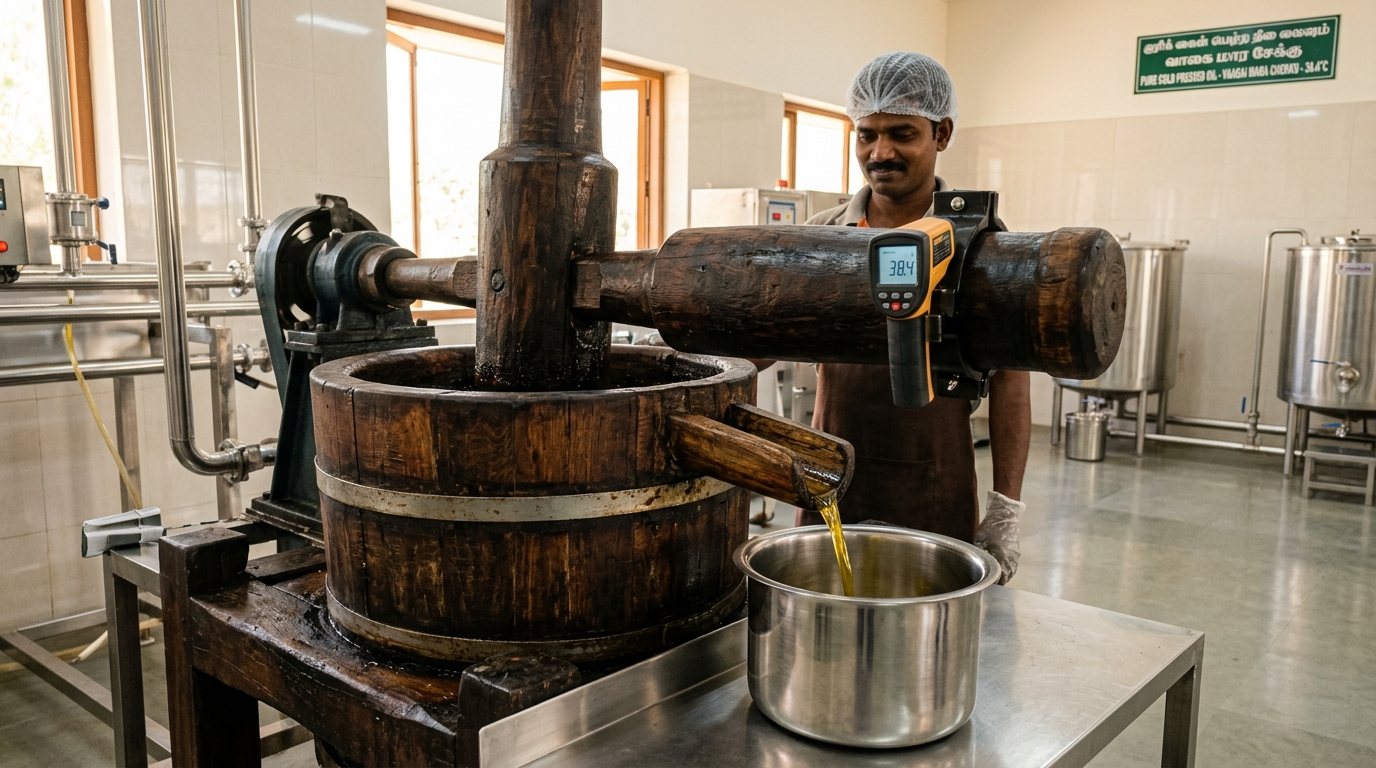
Mara Chekku: Why Wood Outperforms Metal
In standard commercial oil extraction, metal screws in high-speed expellers rotate at 80 to 120 RPM. The harsh friction between metal parts rapidly drives temperatures up to 85°C–90°C. At this heat, delicate natural Vitamin E (alpha-tocopherol) oxidizes, natural phytosterols degrade, and hydrolytic free fatty acids increase.
Kshetra uses traditional mortar and pestles carved from dense Vaagai wood (Albizia lebbeck). The wood naturally cushions mechanical shock, absorbs friction, and dissipates heat. Rotating at an ultra-slow 12 to 16 RPM, the temperature of the oil never exceeds 45°C throughout the entire pressing cycle.
Three Extraction Methods Compared
Understanding the radical chemical differences between traditional wood pressing, industrial expellers, and solvent extraction.
| Process Parameter | Kshetra Vaagai Wood Ghani | Standard Metal Expeller | Industrial Solvent Extraction |
|---|---|---|---|
| Crush Mechanism | Slow rotating wood mortar & pestle (12–16 RPM) | High-speed steel worm-screw (80–120 RPM) | Petroleum-derived Hexane chemical bath |
| Extraction Temperature | Strictly < 45°C (Typical 38°C) | 70°C to 90°C friction heat | 65°C (Hexane) then 240°C steam deodorizing |
| Chemical Solvents Used | 0% (Zero Chemicals) | 0% (Mechanical only) | Hexane bath (ppm residues regulated) |
| Filtration Method | 48-Hour gravity settling + cotton cloth | Plate & frame filter press | Caustic soda + bleaching earth clay + deodorizer |
| Nutrient Retention | Natural tocopherols & sterols intact | Moderate thermal loss of Vitamin E | Completely stripped of natural nutrients |
| Natural Aroma & Color | Authentic golden hue, rich seed aroma | Darker due to heat, slightly burnt undertones | Artificially bleached clear; deodorized neutral |
From Single-Origin Seed to Numbered Bottle
Air-Screen Cleaning & Moisture Stabilization
Seeds arrive directly from regional farm clusters. They are cleaned across vibrating aspirators to remove dust and broken hulls. Moisture is tested; only seeds with natural moisture between 5.0% and 6.5% are accepted for cold-crushing.
Gentle Crushing Below 45°C
The cleaned seeds enter the Vaagai wood chamber. Over a 45-minute slow crush, oil is gently expressed under gradual pressure without external water heating. The calibrated sensor logs temperature continuously.
48-Hour Conical Settling
Freshly pressed oil contains natural crushed seed micro-particles. The oil rests in food-grade SS-304 stainless steel conical settling tanks for 48 to 72 hours, allowing heavy solids to settle naturally to the cone apex by gravity alone.
Micro-Screen Polishing without Bleaching Earth
The settled oil is decanted through dual-layer unbleached khadi cotton fabric. Unlike commercial refineries that use acid-activated bentonite clay or diatomaceous earth, our cotton filtering leaves natural plant beta-carotene and aroma untouched.
NABL Batch Clearance & Numbered Bottling
Samples from each settling tank are dispatched to independent NABL-accredited analytical laboratories. Once Free Fatty Acids, Peroxide Value, Aflatoxins, and purity tests pass, the batch is released into dark amber pharmaceutical glass bottles and laser-coded with its unique batch ID.